Monday, August 13, 2018

Net Promoter Score (2018) for IBM compared with other top brands

This is for the IBMers out there, current employees and past (including old retirees like me) …

To quote:

NPS is a customer loyalty metric that measures customers’ willingness to not only return for another purchase or service but also make a recommendation to their family, friends or colleagues.

It is a powerful and effective technique, which can greatly increase a company’s revenue if used properly.

The main advantages of NPS are close correlation with a company’s growth and easy collection, interpretation and communication of the data.

Is IBM’s NPS of 27 considered to be good?

Yes, it is.

Net Promoter Score is a number from -100 from 100.

Scores higher than 0 are typically considered to be good and scores above 50 are considered to be excellent.

The industry average for Consumer Brands / Electronics is 45.

Mouse across the infographic on the above web page to see how IBM compares with other well-known brands.

Click on the screenshot below to see the article:

Wednesday, July 25, 2018

Refilling ALDI coffee capsules, for limited edition or unavailable flavours

A few months ago I purchased a pack of Irish Cream Expressi coffee pods (capsules), which use the K-Fee pod system.

imageThe Irish Cream pods are one of ALDI’s limited editions, which they sell from time to time and there’s no guarantee that they’ll ever be sold again.

Another limited edition that I’m trying right now is Rwanda, and both of these are shown in the adjacent photo number “1” (click image to view enlargement).

Unfortunately my wife has taken a liking to the Irish Cream flavour, and I had to inform her that when the pack of had been used up there would be no more on offer from ALDI – a problem with ALDI for lots of other items too.

Several years ago I had investigated the emptying of the pods and refilling with non-ALDI coffee flavours.

Back then my results were mixed, because all the pods that I tried had to be sealed off at the top somehow, a my experiments using cling wrap to do the sealing weren’t very satisfactory. So I fairly quickly gave up on doing any refilling.

Because of my wife’s Irish Cream impending crisis, I resumed my investigations into refilling the pods, knowing that this flavour is available from other sources.

Café Palazzo is one such source, and they also offer my favourite flavour French Vanilla shown as number “2” in the photo.

I was pleasantly surprised to discover that in 2016 – unlike when I did my experiments several years ago -- most (but perhaps not all) of ALDI’s Expressi pods in 2018 come with a plastic filter that snaps into place at the top of the pod sufficiently well to prevent the ground coffee from coming out of the pod during the brewing process.

In the photo, number “3” shows a pod that has been washed out, and “4” shows a pod being refilled with French Vanilla coffee. The refilling process is a little time-consuming and a bit messy, but it’s something you can live with.

A little Web surfing (include several demos on YouTube) shows that others had alre1ady mastered this technique some years ago, and had come to much the same conclusion.

I certainly don’t claim the be the first to do this, my post is as much railing against ALDI’s attitude to not repeating Limited Edition coffee pods as much as anything else!

Bad German Engineering - Mercedes C180 coolant expansion system weak points [UPDATED]

Why on earth did the Mercedes engineers use weak plastic connectors (marked A and B in the images below) in the C180 Kompressor model W205 engine coolant expansion system?

These two weak points tend to break, and break again - and Mercedes has the temerity to charge and arm and a leg to replace them.

The cost of the field replaceable unit (image 1) is approximately AUD $150 to $160.

It's crazy that the broken connector (marked A in image 2 below) cannot be purchased separately for a few dollars!

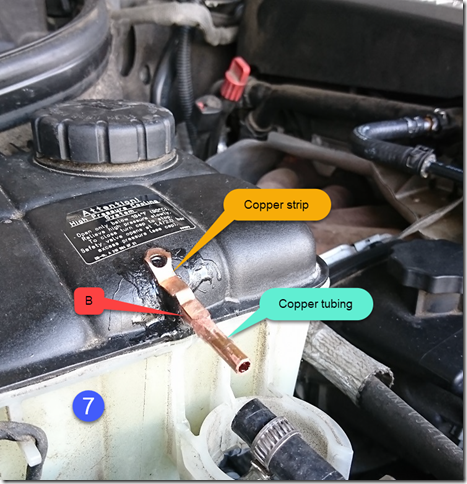
I used copper tubing to rebuild connector A …

Image 5 below shows the finished repair:

Just when I thought that I had finished the repair, to my great annoyance the plastic connector on the coolant expansion tank snapped off. It was too weak to withstand the stress of reattaching the rubber connecting tube at point B.

You can assess just how exposed to being broken it is from image 6 below. When this fragile connector (B) breaks off the entire tank becomes useless, and your vehicle is rendered effectively undriveable.

So it looks like I'll have to try using copper tubing to rebuild the pipe on the coolant expansion tank. Otherwise a replacement tank will be needed, at a cost of around AUD $100, and that's inexcusable.

Obviously not all Mercedes Benz engineering design and implementation features reach the exalted heights often associated with the Mercedes name. So-called "German engineering excellence" – Phooey!

Examine just about any product of any sort (and that certainly includes software), developed by any organisation anywhere in the world, and you’ll find weak points without having to look too hard.

UPDATE (26 July 2018)

Yesterday I filed the end of a 3 or 4 cm length of copper tubing so that it was a snug fit into the hole left at the top of the coolant expansion tank. I also prepared a small copper strip to sit on top of the tubing and used epoxy resin (Selleys Araldite brand, here in Australia) to glue the tubing and strip in place. Then, it being cool winter weather in Melbourne, I waited a day to allow the epoxy resin to set firm.

Here’s what my latest burst of jury rigging accomplished (image 7):

image

Today I gingerly tested the strength of the bond, and it seems to be pretty strong, I would say at least as strong as the stupid original plastic tube shown in image “6”.

The only thing left to do is to start driving again and keep a watchful eye out for the “Check coolant level” warning, hoping never to see it again. Only time will tell.

By the way, I highly recommend Solvol heavy-duty hand cleaner for washing your hands after work such as this. It comes in a convenient bottle as shown below:

image

Monday, July 16, 2018

Are Australia’s Big Four banks effectively bankrupt (and will they pursue you to the grave)?


The Australian government claims the banks are “unquestionably strong”. The Australian Prudential Regulation Authority (APRA) is given credit for this strength, through its supervision of the banks through the 2008 global financial cri sis, and its subsequent lifting of the banks’ capital from 9.5 to 14.5 per cent of their assets.

If anything, APRA is sometimes criticised for making the Big Four banks too strong and profitable, because it has come at the expense of competition in the banking sector, and the banks’ duty of care for their customers, hence the misconduct and abuses being exposed by the royal commission. APRA ignores such complaints, pointing to its mandated responsibility for “financial stability”—strong, profitable banks, even though an oligopoly, make for a stable financial system.

At least, that’s the story.

Hiding in plain sight is a glaring contradiction to this claim of financial stability, which is Australia’s world-record housing bubble. Australia’s Big Four banks are more exposed to the housing market than were their counterparts in the USA, UK, Spain and Ireland when they suffered banking crashes following the collapse of the real estate bubbles in those nations in 2008. Around 63 per cent of Australian bank lending goes to mortgages—compared with 30 per cent in the USA; between 20 and 30 per cent in the UK and Canada; and 15 per cent in Hong Kong. The borrowing that has fuelled this bubble has driven up Australian household debt to around 200 per cent of annual household income and 120 per cent of GDP.

Not everyone accepts the housing market is a bubble, and that determines their view of the health of the banks. For instance, the government, regulators and banks, which hold that the banks are “unquestionably strong”, all deny the bubble. Those who acknowledge the bubble recognise that the financial system is in fact extremely unstable, and teetering on the edge of a crash that will bankrupt the banks.

Eerie precedent

There are striking similarities between Australia today, and Ireland before its banks crashed in 2008. In the lead-up to the September 2008 global financial crisis, virtually the entire nation of Ireland was euphoric about its economic boom, centred on real estate development. Sound familiar? And 28 per cent of bank lending went to property developers, slightly less to mortgages—combined still less than the 63 per cent of Australian banks’ lending to housing.

One economist, Morgan Kelly, had warned for a year that Irish real estate was a bubble, but his warnings were met with universal denial. Also sound familiar? The denial was so ingrained that when the September 2008 crisis impacted the liquidity in Ireland’s banks, the Irish government announced it was guaranteeing the banks, confident that they were well capitalised and that the guarantee would be enough to see them through the liquidity crunch.

Within weeks the Irish property bubble burst and the banks collapsed. As the government was on the hook for the banks’ losses, the government bailed out the banks, and then itself required a bailout from the EU, which dictated crushing austerity on the people of Ireland.

Early warnings

Among a limited number of organisations and individuals, the Citizens Electoral Council has long warned that Australia’s housing market is a bubble and heading for a crash. As early as 2007, CEC press releases questioned whether one or more Australian banks were in danger of collapse due to the brewing mortgage crisis and their derivatives. Unbeknownst to the CEC at the time, bank regulator APRA had in early 2007 suppressed an internal report which revealed that due to the lowered lending standards APRA had approved, the banks had extended 3.4 times more credit into mortgages than they would have, had they stuck to their previous, higher standards.

The report effectively identified a bubble. It also foreshadowed a sharp rise in mortgage delinquencies, a possible mortgage crash, and a recession. Given that this report coincided with the early alarms in the United States about rising defaults on sub-prime mortgages, it should have spurred Australian authorities to act; instead APRA kept the report secret, and it only came to light in an April 2016 report on ABC 7.30. As it happened, 7.30 observed, the eruption of the global financial crisis in 2008 drove Australian authorities to slash interest rates and pump money into the housing market, which averted the property crash and recession that the report had warned of: “But some say that has merely allowed the problem to get far worse, with mortgage debt doubling since APRA’s alarming research was carried out.” (Emphasis added.)

So where do the banks stand today?


Bubble of lies

The mortgage portfolios of the Big Four banks account for 80 per cent of Australia’s $1.7 trillion mortgage market. At least $500 billion worth of these mortgages are identified as so-called “liar loans”, meaning they were based on false income and expense information.
image

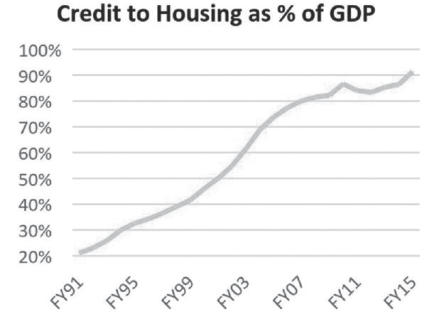
The volume of credit that has gone into housing has soared, creating a
world record housing bubble. Source: John Adams

However, as Denise Brailey of the Banking and Finance Consumers Support Association (BFCSA) insists, and as the royal commission has confirmed, the liars were the banks, not the borrowers—the banks doctored loan applications to record household expenses at the equivalent of the poverty line. An even bigger chunk of these mortgages are interest-only, reflecting the inability of borrowers to repay interest and principal at current house prices.

Interest-only loans reached a peak of 40 per cent of all mortgages in early 2017, following a spike in the rate of interest-only lending that got to almost 50 per cent of mortgages issued in 2016 (compare this with the US rate of interest-only lending before the 2008 crash, which peaked at 25 per cent of mortgages in 2006).

These are official figures, but Denise Brailey reports that the mortgage brokers she surveys reveal that the actual rate of interest-only loans they write is more like 80 per cent. This wave of interest-only loans in recent years is starting to reset to interest and principal, which is almost doubling monthly payments, and that’s before any rise in interest rates. In October 2017 UBS reported its survey that found a third of borrowers with interest-only loans were unaware that their loans were interest-only and they weren’t repaying principal, which sets them up for an even greater shock when their mortgages reset.

Threat of rising interest rates

This mountain of mortgage debt is therefore extremely vulnerable to rising interest rates. According to the latest survey by Finder.com, an extra $100 per month in mortgage payments would push 54 per cent of borrowers over the edge. Martin North of Digital Finance Analytics warned ABC on 11 July that even a 15 basis point (0.15 per cent) rise in interest rates could push a million households into delinquency by September.

The Reserve Bank of Australia’s cash rate is at the record low level of 1.5 per cent, unchanged for the longest period in RBA history. But the best efforts of the RBA cannot shield Australia from rising rates overseas. The banks rely on overseas borrowing for 40 per cent of their funding, and bank liabilities make up the majority of the $465 billion in Australia’s foreign debt that has a maturity of 90 days or less. Therefore when this debt is rolled over every three months, they have to take the interest rate on offer. As foreign observers have been shocked to discover, 80 per cent of Australian mortgages are variable-interest-rate loans, so the higher borrowing costs that the banks incur will be passed on immediately to already overstretched households ‘Unquestionably weak’ capital The truth is that the banks are also dangerously overstretched.

The claim that bank capital is at the “unquestionably strong” level of 14.5 per cent is based on the ruse of “risk-weighting”. This scam allows the banks to claim that only a quarter of their mortgages carry risk, and only hold capital against those mortgages, not all of them. The actual capital of the Big Four banks is razor thin, less than 6 per cent, meaning their leverage of loans to capital is 19 times.

Given that the collateral for 63 per cent of this lending is overpriced housing, an across-the-board real estate market slide of just 10 per cent would wipe out collateral equal to the banks’ capital. Australian house prices have already fallen 4.6 per cent in the last year, and informed observers are anticipating falls of 30 per cent and more. Without collateral backing their loans, the banks would be entirely at the mercy of households making repayments on the liar loans that the banks knew they couldn’t afford in the first place.          

Australians are far less likely to default on their mortgages than Americans, due to Australian mortgages being full recourse, meaning the banks can pursue borrowers to the grave; however, there is a limit to what any household can take, and Australian households are reaching that limit. Not only are they already overstretched, but falling prices will trap increasing numbers in negative equity, meaning they owe more than their house is worth.

Such a demoralising plight will trigger outright defaults, especially by the large percentage of “investors” in the market. On top of that, the thousands of job losses in high-paid automotive industries in recent years, and 8,000 high-paid Telstra jobs to go in the next few years, could also trigger a wave of defaults, to be followed by even more as falling house prices flatten the construction industry, which grew into Australia’s second-biggest economic sector on the back of the bubble.

Derivatives

The banks’ bogus capital claims also do not properly reflect their exposure to derivatives, the “notional principal” of which has soared from $14 trillion in 2008, to $40.56 trillion according to the RBA’s latest figures. Most of these derivatives are in one way or another bets on their mortgage lending. Banks always understate their derivatives risk, because they ignore the possibility of extreme events like the 2008 GFC—or a collapse of Australia’s housing bubble.

As unbelievable as it may be, Australia’s financial authorities are not paying attention to this looming danger. A well- placed sourced informed this author that a very senior political-economic expert in Australia in early June asked the RBA if it assesses and manages systemic economic risk, but was informed that was APRA’s job, not the RBA’s. Experts familiar with APRA, however, including former APRA principal researcher Dr Wilson Sy, know that APRA is not assessing and managing risk; in fact, APRA doesn’t even have a research department anymore.

image

The ruse of risk weighting allows banks to claim they have increased their capital to
the “unquestionably strong” level of 14.5 per cent (top line), whereas actual capital
has barely changed, remaining around 6 per cent (bottom line). Source: Investment Analytics

Conclusion

Banks hold capital as a buffer against possible defaults. APRA has allowed, actually encouraged Australia’s banks to run up a massive exposure to mortgages and mortgage-related derivatives, against razor-thin capital. With borrowers at the extremes of their limits and interest rates rising, there’s no way the housing bubble won’t burst at some point in the near future, and there’s no way that wouldn’t crash the banks. Right now, Australia’s banks are dead men walking, effectively bankrupt.

-------------------  ATTRIBUTION  -------------------

Citizens Electoral Council of Australia
Postal Address: PO Box 376, Coburg Vic 3058
Phone: 1800 636 432 Fax: 03 9354 0166
Home Page:
www.cecaust.com.au   Email: cec@cecaust.com.au
Authorised by R. Barwick, 595 Sydney Road, Coburg, Victoria 3058.
Printed by Citizens Media Group Pty Ltd., 595 Sydney Road, Coburg, Victoria 3058. Independent Political Party
11 July 2018

Friday, July 06, 2018

WinExt Pro–a very nice utility for trimming, tracking and synchronizing drives on Windows systems

I’ve just installed and tested WinExt Pro and found it to be a a well-designed, nice looking and functional software product. There’s a free version as well as the WinExt Pro paid version.
My first run was against one of the 250 GB SSD drives on my main desktop system, as shown in the first screenshot:
image

A fairly quick scan was followed by a somewhat slower analysis phase, and then the following nice-looking report was displayed:
image
As you can see, in the top section of the report only the potentially deletable files are checked, so you can regain wasted storage space by simply clicking on the trashcan icon, it’s as easy as that.

There are other useful functions available, such as monitoring activities against files like creating, deleting or modifying them, which are described on the WinExt Pro product page so why not go take a look?

Tuesday, June 12, 2018

Blonde jokes – sexism goes awry

A blonde man is in the bathroom and his wife shouts: "Did you find the shampoo?"

He answers, "Yes, but I'm not sure what to do… it's for dry hair, and I've just wet mine."
------------------------------


A blonde man spies a letter lying on his doormat.

It says on the envelope "DO NOT BEND ."

He spends the next 2 hours trying to figure out how to pick it up.
------------------------------


A blonde man shouts frantically into the phone, "My wife is pregnant and her contractions are only two minutes apart!"

"Is this her first child?" asks the Doctor.

"No!" he shouts, "this is her husband!"
------------------------------

Image result for dumb blonde man cartoon

A blonde man is in jail, the guard looks in his cell and sees him hanging by his feet.

"Just WHAT are you doing?" he asks.

"Hanging myself," the blond replies.

"The rope should be around your neck" says the guard.

"I tried that," he replies, "but then I couldn't breathe."
------------------------------


An Italian tourist asks a blonde man: "Why do scuba divers always fall backwards off their boats?"

To which the blond man replies: "If they fell forward, they'd still be in the boat."
------------------------------


A friend told the blonde man: "Christmas is on a Friday this year."

The blond man then said, "Let's hope it's not the 13th."
------------------------------


Two blonde men find three grenades, and they decide to take them to a police station.

One asked: "What if one explodes before we get there?"

The other says: "We'll lie and say we only found two."
------------------------------

A woman phoned her blonde neighbor man and said: "Close your curtains the next time you nd your wife are having sex. The whole street was watching and laughing at you yesterday."

To which the blonde man replied: "Well the joke's on all of you because I wasn't even at home yesterday!
------------------------------

Friday, June 08, 2018

Allavsoft’s excellent Video Downloader and Converter for Windows (and Mac)

I’ve gained some experience in downloading video files over that last decade or so, and thought that I knew a fair bit about what’s tools are available.


But, much to my surprise, there was one very nice product called Allavsoft Video Downloader and Converter for Windows which somehow I didn’t come across until just a month or two ago. There’s also a Mac version too.


My first impressions were very positive, so I immediately purchased a licence. After having used it  for several weeks I really do like its core capabilities, and am very happy with the purchase.
NOTE: this review was originally posted on 08 June 2018, and was updated on 28 June 2019 to correct some typos and streamline the document flow as well as adding a few extra points that impressed me during a full year of consistent and heavy use of Allavsoft.

I’ll outline some of Allavsoft's download features below, together with a few enhancement suggestions that I reckon will turn it from a very good product into an outstanding one -- especially for  somebody who downloads lots of videos (from YouTube, or any of the many other video sites that Allavsoft supports).


When Allavsoft has finished downloading a video file it optionally can convert from the original file format to another (for example, from MP4 yo AVI, WMV, MOV, MPEG-1, MPEG-2, VOB, ASF, RMVB, DV, TS, Apple ProRes, WebM, FLV, OGV).


It so happens that most of the videos I download are in MP4 format and I don’t want to convert to some other format, so I won’t be covering this aspect at all. If video formats are important to you, I strongly recommend that you take it for a test run to check out the conversion capabilities.


Because Allavsoft is very straightforward to install and operate, I’ll not discuss this and will only be giving a few main impressions and certainly not a detailed step-by-step run-down on the product. I’ll only cover things that I found to be important for a seasoned downloader, leaving out details in order to reduce the length of this blog post.


SNAGHTML30e1d31

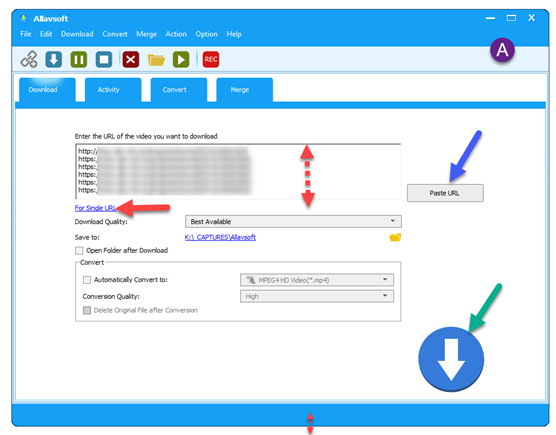
Referring to screenshot (A): the default is to process a single video URL but (where the solid red arrow is) I wanted to process multiple videos from a miniseries, so have pasted their multiple URLs into a list box (dashed red arrow at top).


If your list contains more that three URLs, a vertical scroll bar appears, but if you like (see bottom dashed red arrows) you can drag down the bottom margin of the window to increase the depth of the list box.

To initiate downloads, you press the big blue button at bottom right (pointed to by the green arrow).
And here’s my first recommendation to the Allavsoft developer team -- that this big blue download button can be made smaller and it should shifted up adjacent to the “Convert” section. This will allow the entire window to be made smaller by removing all that wasted space in the bottom left quadrant of the window. It would be better if the list box was made deeper, so that you can paste more URLs and view them without scrolling up and down.

When downloads are occurring, you click on the “Activity” tab and see something like the following:
image

Screenshot B shows a nice, easy to understand user interface, nothing to complain about here. Except, as my second request to the Allavsoft developer team, that I found (after doing a bunch of multiple downloads) that in practice each individual download takes up too much screen space.

So I would very much appreciate being able to switch to a terse display mode where each download was on a single line (without a thumbnail image, or maybe with a tiny one), enabling 3 or 4 times as many downloads to be viewed without vertical scrolling. I tend to do my video downloading in bursts, and a terse mode would be very efficient for me. 

At the very least, I would like to see the thumbnail images reduced in size by 50 percent, which woukd immediately allow more downloads to appear in the Download pane. (This recommendation was added in the June 2019 update of this review.)

There’s a handy context menu (right mouse click) that makes it simple to select various options, as follows:

image

If you do multiple concurrent downloads, the (as shown in screenshot D) you can control how many are allowed to run simultaneously:

image

The maximum is seven simultaneous downloads. I would like to see this limit raised to at least 10 simultaneous downloads, or even 20, because my system is quite powerful and could handle this. (It’s an AMD Ryzen 7 processor with 16 CPU threads) and I have a quite fast broadband connection (HFC cable running usually at 90-95 Mbps during off-peak times.)

June 2019 update: I was early on advised by David from the Allavsoft support team -- who, by the way, I have found to respond very quickly, usually within an hour or two -- that you can get additional control over the preferences by holding down the Ctrl key while clicking your mouse on the "Preferences" menu option:

For example, the default maximum of seven concurrent downloads can now be exceeded:


Here I will point out that this Allavsoft downloader is quite a speed demon, handling concurrent downloads with aplomb. I was even very pleasantly surprised when downloads from one source were running flat out, using up all my available 95 Mbps HFC bandwidth. 

Upon investigation, I discovered that each large video file gets downloaded concurrently as small chunks or segments rather than as a single thread, with the segments getting recombined into a single MP4 file right at the end. 

I have found that it's not wise to select more than about 10 concurrent downloads, because at the end of a download when all the chunks are combined together the CPU load can become extremely intense and especially so if several videos happen to be recombined at the same time.

For example, with Allavsoft downloader a 1 GB movie might take 4 or 5 minutes to download, whereas in the past -- using another downloader that couldn’t do this -- the same movie might take 30 or 40 minutes to download. Kudos to the Allavsoft developer team for all this!

Screenshot E just below shows some of the other settings that enable you to fine tune your downloading:


image

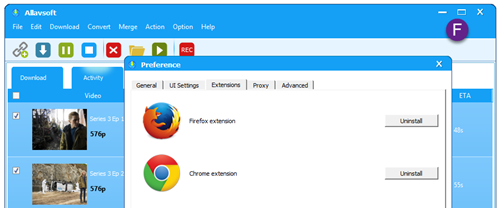
Screenshot F shows that some browser extensions are available, though I haven’t gotten around to testing these:

image

When your downloads finish, there are the usual things you can do (shown in screenshot G), such as opening the video in Windows Explorer (F8) or playing it (Shift+F8):

image

ADDENDUM: In the first version of this blog post I forgot to mention that there’s a very large number of supported video sites including sites that other downloaders don’t support. For example, Australian sites such as ABC iView and SBS On Demand to name just two. Take a look at this comprehensive list yourself. 

SUMMARY: As I mentioned at the outset, this isn’t a comprehensive review of Allavsoft Video Downloader and Converter, but I hope that I’ve given you a taste for it and I certainly do recommend it for purchase. At the moment (8th June 2018) and for the next few days there’s a 50% discount on both Windows and Mac versions.

I’ve made a few enhancements requests, and invite the Allavsoft team to contact me directly to discuss these (and others) in depth.


Wednesday, May 30, 2018

Staying happy as you age

See How Happiness Changes With Age - Becoming okay with being boring


And here's a smart way of getting happy as you age (recently sent to me):

10cbf09b

Perhaps when you get old enough you can retire and no longer have to work pointlessly, see:
On the Phenomenon of Bullshit Jobs   (with
this comment at Bloomberg)

Sunday, May 20, 2018

The sort of people who read various Australian newspapers

I just received this in via e-mail, and think it’s worth sharing.

Some Australian papers are missing from the list, such as The Guardian (Australia edition), as are most smaller/regional papers. Here’s a fairly complete list of Australian papers.

It set me wondering what could be said, in a similar vein, about readers of newspapers published in other countries. Feel free to add your comments!

----------------------------------------------------------------------------------------------

1. The Australian Financial Review is read by the people who run the country.

2. The Canberra Times is read by people who think they run the country.

3. The Australian is read by people who think they should run the country, and who are very good at crossword puzzles.

4 The Sydney Morning Herald is read by people who think they ought to run the country but don't really understand The Australian.

5. The Courier Mail is read by people who wouldn't mind running the country, if they didn't have to leave Queensland to do it

6. The Age is read by people whose parents used to run the country.

7. The Melbourne Herald Sun is read by people who aren't too sure who's running the country and don't really care as long as they can get a seat on the train and read Hagar and Snake

8. The Sydney Daily Telegraph is read by people who don't care who is running the country as long as they do something really scandalous, preferably while intoxicated.

9. The West Australian is read by people who are in prison, who used to run the state, and would like to do so again, as would their constituents who are currently free on bail.

10. The Hobart Mercury is (slowly) read by people who are running another country, but need the Aussie Rules scores.

11. Crikey is read by people who aren't sure if there is a country or that anyone is running it; but if so, they oppose all that they stand for. There are occasional exceptions if the leaders are gay, handicapped, minority, feminist, atheists, and those who also happen to be illegal aliens from any other country or galaxy, provided of course, that they are not conservatives.

12. The Adelaide Advertiser is read by people trapped in a line at the supermarket waiting for the electricity to come back on.

13. The Northern Territory Times is read by people who have recently caught a fish and need something to wrap it in.

Monday, April 23, 2018

nOracle - a strange, questionable website

nOracle
QuestiOns nO answers

nOracle is nO Oracle

nOracle has nO answers

Only QuestiOns

nOracle thinks, it's rarely black Or white

� what dO yOu think ?

image

---------------------------------------------------------


Stumbled upon this website yesterday.
https://www.noracle.net/

Here are the questions:
https://www.noracle.net/questions/

Here are the answers:
https://www.noracle.net/answers

I have my own questions:
Why would anybody create such a site?
What was their thinking behind it?