Monday, March 13, 2006

Firefox Browser Share reaches 25 percent ... at asiapac.com.au

Just for the record ...

Using SiteMeter I've been tracking browser share (and other statistics) since putting up my web site four or five years ago: asiapac.com.au and later its mirror image notestracker.com

A couple of years ago Internet Explorer (IE), in its various versions, consistently represented more than 90 percent of site visits. For many months IE had around 97% to 98% of browser share.

It has been interesting to watch the steady growth of Firefox during the last year or two. It's the only other browser that has ever exceeded one or two percent of site visits.

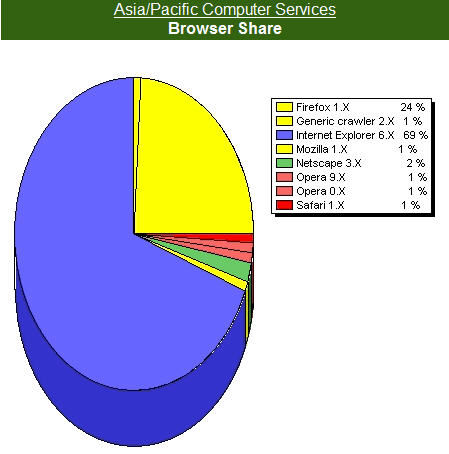
My web site has a quite constant visit rate, even if not very high one compared with lots of others. I've found that for the last three or four months the Firefox visit share has been fluctuating quite a lot from week to week, ranging between 10% and 20% but tending more towards the latter. To illustrate, here are the figures for 13 March 2006:

Asia/Pacific Computer Services: browser statistics as at 13 March 2006
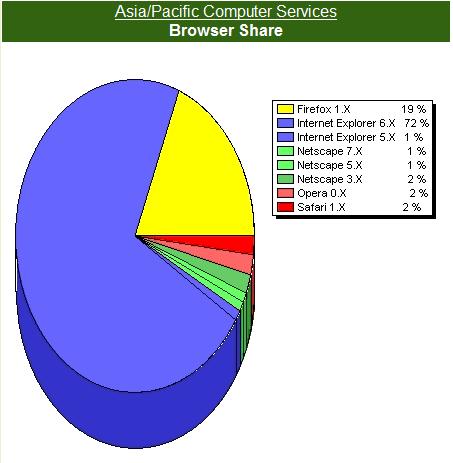
And what about two days later? Here is the breakdown for "the ides of March" (bad for Julius Caesar, bad for Firefox):

Asia/Pacific Computer Services: browser statistics as at 15 March 2006

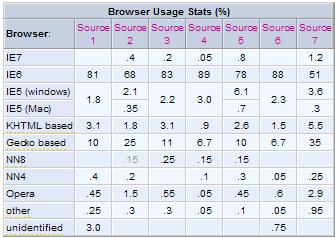
These seems to correlate fairly well with statistics from sources such as Browser News, as per their report for today:


I wonder what the eventual impact of IE7 will be. It won't be for a year or so that we can assess IE7's popularity. (I've tried out the IE7 Beta2 and it seems quite nice, but with quite a functional and usability issues -- quite limited tailorability, shortcomings in tabbing capabilities, inconsistencies with keystroke binding, and more -- which I sincerely hope Microsoft will address before the final release.)

UPDATE - 22 April 2006:
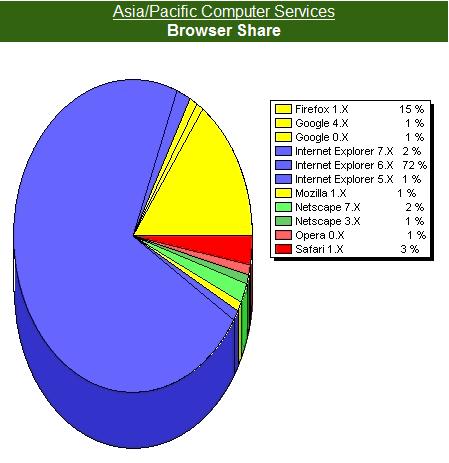
Today, the Firefox share reached its highest ever, at very close to one quarter of visits to asiapac.com.au -- combined with its mirror at notestracker.com that is.

Firefox browser share at asiapac.com.au (and notestracker.com) approaches 25 percent in late April 2006.
What with the release of Internet Explorer 7 (IE7) still months away -- perhaps late 2006 -- it looks as though Firefox will continue to gain an even healthier share in the renewed "battle of the browsers". Meanwhile Opera 9 Beta has just been announced, introducing Widgets, content blocker and integrated BitTorrent support.

Wednesday, March 08, 2006

Trio of Free Databases from Major Vendors

2005 and 2006 have certainly been good ones for those seeking inexpensive or free databases.

Not only were there already free open-source DBMSs such as MySQL as well as related toolkits like Hibernate, but most recently (in late 2005 and early 2006) the three major vendors in the DB arena themselves came out with no-charge versions of their key commercial database products.

Here's a summary of their new free products. This summary is also posted at http://asiapac.com.au/Links/Database.htm (Australian server) and http://notestracker.com/Links/Database.htm (U.S. server).


THE database phenomenon of 2005 / 2006 -- feature-laden, industrial-strength FREE versions from the leading DB vendors!

  • IBM DB2 Express-C for Linux and Windows (DB2 Express community edition) - a no-charge data server for use in development and deployment. Providing the same core data server features, development interfaces as well as system limits as DB2 Express in a smaller package, DB2 Express-C offers a solid base to build and deploy all applications including: C/C++, Java, .NET, PHP, and more. DB2 Express-C is available for Linux and Windows running on 32 or 64 bit hardware with up to two CPUs and 4GB of memory. Unlike other free databases, DB2 Express-C does not impose any database size limit, no limit on the number of instances or databases per server and no restriction on the number of users. ... Should you require a data server with more advanced features and 7x24 support from IBM, it can be seamlessly upgraded to DB2 Express, DB2 Workgroup and DB2 Enterprise Server Editions without modifying your database or your application


  • Oracle Database 10g Express Edition (Oracle Database XE) -- an entry-level, small-footprint database based on the Oracle Database 10g Release 2 code base that's free to develop, deploy, and distribute; fast to download; and simple to administer. "You can now develop and deploy applications with a powerful, proven, industry-leading infrastructure, and then upgrade when necessary without costly and complex migrations. ... It can be installed on any size host machine with any number of CPUs, but this free version of the world's leading database will store up to 4GB of user data, use up to 1GB of memory, and use one CPU on the host machine.


  • Microsoft SQL Server 2005 Express Edition - an easy-to-use, lightweight version of SQL Server 2005. It is "free to download, free to redistribute, and easy for new developers to use immediately. Using Microsoft Visual Studio Express or the development tool of your choice, you can start building applications right away. ... Best of all, as your needs grow, your applications will seamlessly work with the rest of the SQL Server product family." It supports 1 CPU but can be installed on any server, 1 gigabyte (GB) addressable RAM, and 4 GB maximum database size.


It could be a while before I have the the time to install and try out any of these three well-respected DB products, but I'm really looking forward to doing so.

There are many things to be considered, and I merely note here that the IBM DB2 Express-C offering does not restrict a database's size to 4 GB and this alone would differentiate it as the product of choice for those databases which you expect will need to store more than 4 GB of data. (This could easily be the case, for example, when there are lots of BLOBs.)

Friday, March 03, 2006

"Web 2.0" and "Web Pi" -- Reject Reality and Substitute Your Own!

In one of his best statements on the fabulous Mythbusters television show, when as often happens (which is the real beauty of the series) one of the experiments doesn't turn out as expected, co-host Adam Savage says: "I reject your reality and substitute my own." Maybe they're moving into computer programming -- lots of myths there -- you can also see them here with "father of Java" James Gosling.

This could be a useful approach to adopt with the currently much-hyped "Web 2.0"with all the articles being written about it, all the claims being made by all and sundry, all the AJAX toolkits appearing out of the woodwork, and the lack of any real agreement about exactly what it all means. Mix that in with the "acronym soup" that we're faced with these days -- SOAP, WSDL, SOA and ESB, WSDL, BPEL, and a myriad others -- and it would be a brave person who claimed to understand what it all means.

CIOs and other IT management therefore have a really tough time ahead of them to make sense of it all and decide which parts of the jumble should be used to further the success of their organizations. An interesting recent article by Edward Cone at Ziff Davis' CIO Insight magazine discusses this: Web 2.0 Reality Check

I encourage you to read the entire article, but a few points made in it are:


  • CIOs in the services era will face their share of problems not only on the technology side but, just as importantly, in dealing with the cultural changes these services will bring to every organization.
  • The whole lengthy cycle of software projects is now on Internet time, and woe to the CIO who fails to keep up.
  • Of all the issues raised by the anticipated service wave ... none are more pressing than the changes in culture necessitated by the new regime.
  • Meeting this demand requires a new way of managing tech projects
  • A danger in this situation is that IT can lose its relationship with the business.
  • IT definitely needs to think differently, because the users want more with services. But if the users think they can do it without IT, they're crazy.
  • One of the biggest headaches with applications on demand is integration with other programs.
  • Tying everything together right also has implications for security, especially identity management.
  • Offline capability is still very important for users. They want productivity maintained if services go down. ... And go down they do.
Much food for thought here.

Joel Spolsky comments in his inimitable fashion that the Architecture Astronauts Are Back with their "meaningless stringing-together of new economy buzzwords in an attempt to sound erudite" and "The term Web 2.0 particularly bugs me. It's not a real concept. It has no meaning. It's a big, vague, nebulous cloud of pure architectural nothingness."

Today's environment is certainly a far cry from the overnight batch runs, fed by punched cards and generating boxes and boxes of printouts, which was still in vogue when I started with IBM in 1970. New-fangled IBM 3270 CRT "green screens" were starting to be introduced in early-adopter mainframe customer accounts, offering direct data entry and immediate display of results and being seen as the wave of the future. We didn't realize it then, but life really was simple in the good old days.

I've read opinion articles predicting "Web 3.0" -- even "Web 2.5" -- and ever onwards to "Web 4.0" and beyond.

I reckon that it's all actually heading asymptotically towards "Web Pi" or "Web π" -- you know,
Pi, the transcendental and irrational number (with a value of roughly 3.14159 26536 to a mere ten decimal places).

We're on our merry way towards "Web Pi in the sky" you could say! The decimal places go on endlessly -- which is what seems to be happening with all of the opinionating and soothsaying about the future of the Web and where information technology is heading. We'll never ever reach our target, but this will provide more opportunity for the technobabble to pour forth and inundate us all.

And if all the word traffic about "Web 2.0" isn't enough, there's another plethora of gobbledegook related to Web Services Architecture ... So many standards have arisen that they need to be referred to generically as WS-* (where the asterisk presumably represents an infinite number)!

- - - - - - - - - - -
STYLE NOTE: the above diatribe was inspired by the British TV series "Grumpy Old Men". I'm actually pretty positive about it all, at the broad level, but the nitty-gritty details get pretty painful at times. I see that the inventor of the Internet seems to be pretty happy where it's all heading too.
- - - - - - - - - - -

UPDATE [30 May 2006]:
Richard MacManus in his Read/WriteWeb weblog has recently commented about the Top Ten Underserved Web 2.0 Markets and in that article points out the following Web 2.0 catalogs: eConsultant's Web 2.0 Directory and Sacred Cow Dung - All Things Web 2.0 -- but nobody yet seems to have started on a Web 3.0 catalog, how bitterly disappointing!

Thursday, March 02, 2006

Perchance to happen upon Serendipity

I just happened upon Scot Berinato's nice little piece In Praise of Serendipity and couldn't agree more:

"Turn off the BlackBerry for a while. Wander—literally or in our minds—with no particular destination. Embrace a little inefficiency and the possibility of greatness that comes with it. Let apples fall on our heads."
For example, five or six years ago, I had a chance meeting with an acquaintance which led to a long and fruitful consulting assignement. In contrast, several months of marketing had not come up with any significant assignments or sales. And like Kekulé I have sometimes woken from a dream with a great idea, have had an inspiration while taking a shower, and have come across key information while casually browsing a book or magazine or while surfing the Web.

How about you? How much has happenstance and serendipity benefited you in your life and work?

It's the old story of "perspiration versus inspiration" ... You must be ready to recognize the occasional serendipitous event when it occurs and welcome it with open arms!

Monday, February 27, 2006

Great Walls -- of Confusion, and "Web 2.0"

If you've been pondering where the Web is heading, then a good round-up of information plus thought-provoking views and opinions can be found in the Web 2.0 Journal, and particularly those of its editor-in-chief Dion Hinchcliffe, such as Web 2.0 and the Five Walls of Confusion or Thinking in Web 2.0: Sixteen Ways

And if you're a fan of usability expert Jakob Nielsen (a favorite author of mine), why not review a few of his articles, including Top Ten Web Design Mistakes of 2005 where he mentions Web 2.0 in passing:
This year's list of top problems clearly proves the need to get back to Web design basics. There's much talk about new fancy "Web 2.0" features on the Internet industry's mailing lists and websites, as well as at conferences. But users don't care about technology and don't especially want new features. They just want quality improvements in the basics.

You really must read the entire article! And while you're at his site, take a look at Durability of Usability Guidelines where he rightly points out that basic usability features don't change all that much over decades.

If you want to delve a lot further into some other peoples' opinion on all this Web 2.0 and blogging stuff, then take a look at Andrew Keen's Web 2.0 - The second generation of the Internet has arrived. It's worse than you think or Nicholas Carr's The new narcissism or Neil Ward-Dutton's Ecosystem vs egosystem to quote just a few.

Sunday, February 26, 2006

A Blog Post A Day Keeps the Doctor Away: Really?

I do like being part of the blogosphere, but its sheer size and hyper-exponential growth are rather intimidating, aren't they? It's a vast world for Internet dilettantes: a place for pleasant diversions and for endlessly stumbling across interesting and useful stuff.

Thus, in the one blogging community that I follow -- that of the of Lotus Notes and Domino -- I just serendipituosly discovered The Sickos and DominoBlogs.com (the latter enabling you to add your own blog to the list of Notes/Domino blogs).

My postings tend to be rather sporadic, because I find so many other things to corner my interest: things in the application development world (Eclipse and MyEclipse, NetBeans, Sun Java Studio 2, Oracle JDeveloper, Microsoft .NET plus Visual Studio 2005, to name some), browsers (IE7 and various others with tabbing support, RSS feeds, etc), Desktop Search (particularly free ones such as Windows Desltop Search, Exalead one:desktop, Blinkx, Copernic Desktop Search, and several others). AJAX, Python, Jython, SMIL, RSS and other types of feed, nd lots more ... not to mention keeping up with happening in the Lotus Notes and Domino arena.

Therefore I only post blog articles in fits and starts, when the spirit takes me. One of Jakob Nielsen's points in Weblog Usability: Top Ten Design Mistakes in Blogs (number 7) is "pick a publication schedule and stick to it. If you usually post daily but sometimes let months go by without new content, you'll lose many of your loyal -- and thus most valuable -- readers." Oh well, rules are made to be broken!

Specifically, I only get motivated to create a posting when I reckon that I've something useful to say that might be a bit different from what anybody else has said and that could be of some real interest and value to others. And this could be a few days or a few weeks or even over a month since my previous posting.

Are you a blogaholic: if you run a blog or two or three, do you get withdrawal symptoms or feel guilty when you don't make daily postings? If so, then you need to get a new life! And if you must make a frequent postings, keep them in mind that a lot of readersus are not in the least interested in trivia: we don't want to know that you had trouble getting out of bed today, what your dog's foibles are, or any equally mundane or inane matter that merely pollutes and poisons the blogosphere. (Talking about poisons: I certainly hope that you're not approaching the extreme posiiton of the Japanese girl described in the article Girl keeps blog on poisoning mother -- then you really do need help, and fast!)

When I joined the IT industry in 1970, it was only a visionary-cum-science-fiction-writer like Isaac Asimov or Arthur C. Clarke or George Orwell who would have foreseen the Internet and its usage as we have it today in the early part of the 21st century. Things that are already commonplace in many parts of the world (but certainly not all of them yet) like broadband connectivity and interactions via blogging, wikis and podcasting all would have been wildly futuristic concepts.

As the saying goes, there's "a time and tide in the affairs of men" -- and at times the tide flows very fast indeed. Is blogging in general and personal blogging in particular going to peak soon? Is the blogging bubble about to burst, as discussed in the Chicago Tribune article Bloggy, we hardly knew ye? This article claims that there are now 20 million blogs worldwide, while Stuart Luman in Linkology writes that there are 27 million of them, showing how they might relate to one another by taking the most-linked-to 50 blogs and mapping their connections.

So if there are 27 millions blogs in early 2006 (or perhaps only 20 million of them), how many will there be by the end of 2006, the end of 2007, etc? There are already far too many blogs to cope with, not to mention RSS feeds, podcasts and all the rest. Do blogs have long-term value and, if so, what is the value? Alex Krupp, a student at Cornell University, expresses the view at http://webservices.sys-con.com/read/172278.htm that:


Few people know that the first webpage ever created, Tim's home page, was actually a blog. Blogs are the epitome of web 1.0. They focus so much on the individual that even Ayn Rand would blush. At their best they can be truly uplifting and inspiring, but on average there are some serious problems with blogs as they exist today. Blogging will be around forever, but I think that personal blogs will be dead in another two or three years.

and he goes on to talk about Web 2.0 and collaborative blogging and more:


    • Web 1.0 is about allowing individuals to create and share ideas
    • Web 2.0 is about allowing groups to create and share ideas
    • Web 3.0 is about allowing societies to create and share ideas
    • Web 4.0 is the singularity
Plenty of interesting times ahead, for sure. It would be nice to be sure about what the winner and loser technologies will be, what will last and what will disappear.

To conclude, if you only add a new blog article when you have something valuable to contribute, that's okay -- no feelings of guilt necessary if you don't post every day!

Quality always wins out over quantity. And as the sheer number of blogs reaches 30 million and then 40 million and still keeps growing, a few less postings by you or me or anybody else certainly won't be missed.
Friday, February 17, 2006

The brrreeeport blogging experiment

Read Scobleizer (Robert Scoble's blog) to find out about this experiment.

Try a search using Google -- or other search engine -- on this specific manufactured term: brrreeeport

And, while you're thinking about what this all might mean, take a look at some definitiiions of critical theory ... http://www.google.com.au/search?q=define%3A+critical+theory&start=0&ie=utf-8&oe=utf-8&client=firefox-a&rls=org.mozilla:en-US:official

And finally, here's a link to BlogCode.com ... "a fast, easy and intuitive source of blog recommendations based on the StoryCode.com model."

It all seems to be self-fulfilling and "incestuous" to me!

Tuesday, November 29, 2005

Ray Ozzie's new (Microsoft) weblog

I see that "father of Lotus Notes" Ray Ozzie has started off a new weblog at MSN Spaces and in it has just outlined a very interesting major extension of the RSS feed concept called Simple Sharing Extensions (or SSE). So it may be that the acronynym gets yet another meaning, namely "Really Simple Sharing."

This could prove to be a real winner, if it catches on and can be made to work effortlessly -- particularly if it becomes an open standard.

If done right, SSE could provide a generic and non-proprietary form of two-way synchronization between any two sources.

I'm a big fan of the excellent Lotus Notes replication model (particularly since Release 4, when replication became sensitive to field-level changes not just document-level changes). Notes replication of course is quite proprietary, so it would be great if SSE provides a form of non-proprietary replication between foreign sources.

Ray points out the draft spec for SSE (somewhat abstruse as are all such specification documents), and Frequently Asked Questions (this is quite informative).

Friday, November 25, 2005

Collaboration competition - Microsoft versus Lotus in 2005/2006

Yesterday I attended a Microsoft seimanr here in Melbourne (Australia) and it looks like Visual Studio and SQL Server 2005 are going to be pretty competitlve in many regards. Microsoft seems to be very happy about SQL Server 2005's performance (against IBM's DB2) and equally with the tight integration with their other products (Office, CRM, etc).

There were a few glimpeses of Micrososft "Office 12" due late in 2006 or thereabouts. It seems that the Office underpiinngs have been significantly reworked and Office 12 will have some nice new collaborative features. Pity about having to wait another year or so before it's let loose upon us!

Meanwhile Lotus Notes/Domino 7 has shipped and IBM has the next "Hannover" release well into development. There's a lot of life left in Notes and Domino.

I've ben much closer to Lotus Notes/Domino than to the Microsoft products, so have been doing some research to increase my understanding of the features and positiong of the latter. Here are a few articles that I've looked at recently which give a nice independent summary of the Microsoft collaboration product range:

  1. Increase Efficiency With Collaboration [using Microsoft technologies] - September 2004
  2. Microsoft's Expanding Collaboration Strategy - December 2004
  3. Microsoft Sets Its Sights on Collaboration - October 2005
On the surface, it seems to me that doing things the Microsoft way you have to cobble together a wider range of server products that IBM does with the base Lotus Notes/Domino with maybe a couple of others (such as Sametime). And the author of the third article makes a point about the more unified development model of the Lotus products.

Competitoni is good for us all: it's great to see two of the big players working so hard to bring provide productivity features. If the large attendance at yeasterday's seminar is any indication -- and this was just for Melbourne, it's probably the same all around the globe -- Microsoft certainly is managing to generate considerable interest, despite the regular slippages in their product release dates.

Wednesday, November 23, 2005

What improves your skills as a developer?

Chet Haase, Java 2 Platform, Standard Edition (J2SE) Client Architect at Sun Microsystems, discusses development of the Java client, what can improve your skills as a developer, and what you can do when you feel stumped by a problem ... http://java.sun.com/developer/Meet-Eng/haase/