The fantastic Sysinternals tools are alive and well at Microsoft!
You'll find them at their new Windows Sysinternals home page.
I've just downloaded and carried out a brief check of the powerful new Process Monitor which -- via its extended logging function -- I'm hoping just might be able to help me get to the bottom of my Lotus Domino 7.0.2 server crash problem. This is a Blue Screen Of Death crash that occurs soon after the server is started, as mentioned in several earlier posts. Its cause so far has been inscrutable and elusive: using the Microsoft Online Crash Analysis (OCA) got me nowhere at all, the Microsoft report effectively saying that it was in the "too hard basket" to provide any insights as to the cause.
Friday, November 10, 2006


Thursday, November 09, 2006
Windows Vista might force a flight to Linux? We'll see.
Launch dates and prices have been announced by Microsoft for their next generation of breadwinners, Windows Vista and Office 2007.
I've detected a drawing of breath -- or even a feeling of shock from some -- at the fairly steep prices being asked for these new versions, and not everybody is happy about the cost and inconvenience involved in the purchase of new systems (or upgrading of hardware) and time to learn all the new stuff. For example, see Vista in slow lane for Aussie CIOs and it's likely to be the same worldwide.
A fairly typical reaction would seem to be that of Aussie IT journalist Stan Beer: Vista goes gold and Wintel rides again ... He hopes that "As for all of our old XP boxes, one would hope that there is a good recycling program in a neighbourhood not too far from you."
Could this be the great opportunity for Linux to start making inroads, for those resisting the Microsoft advance?
Not everybody thinks so, and here's a pertinent view recently posted by Adrian Kingsley-Hughes:
I've detected a drawing of breath -- or even a feeling of shock from some -- at the fairly steep prices being asked for these new versions, and not everybody is happy about the cost and inconvenience involved in the purchase of new systems (or upgrading of hardware) and time to learn all the new stuff. For example, see Vista in slow lane for Aussie CIOs and it's likely to be the same worldwide.
A fairly typical reaction would seem to be that of Aussie IT journalist Stan Beer: Vista goes gold and Wintel rides again ... He hopes that "As for all of our old XP boxes, one would hope that there is a good recycling program in a neighbourhood not too far from you."
Could this be the great opportunity for Linux to start making inroads, for those resisting the Microsoft advance?
Not everybody thinks so, and here's a pertinent view recently posted by Adrian Kingsley-Hughes:
The world just isn’t ready for Linux
What They Forgot - Part 1
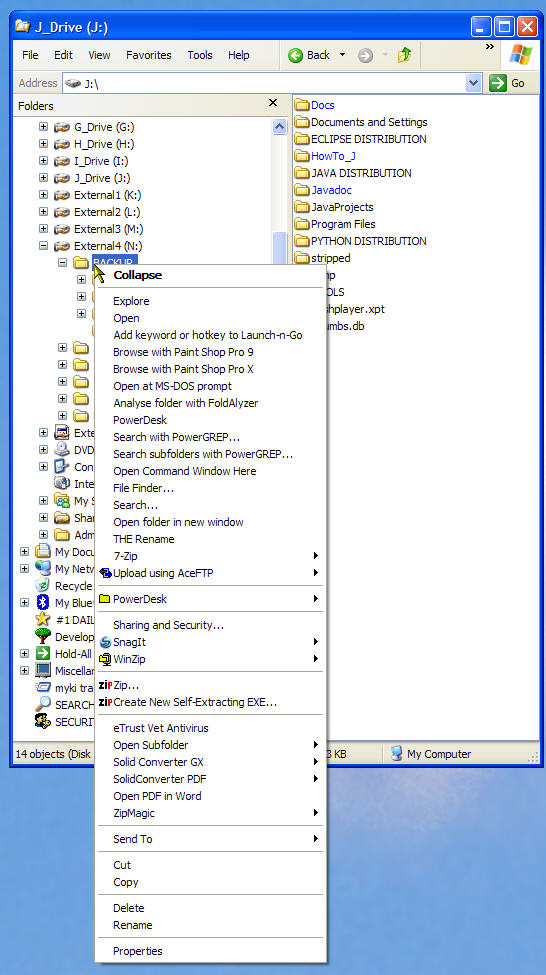 Click the above to see a larger image.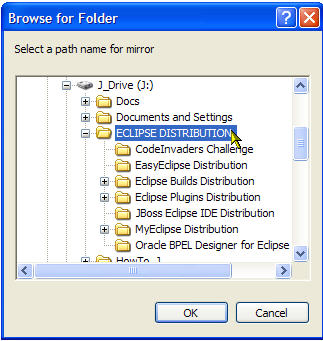
QUIZ:
What's wrong in the above two examples?
What feature or capability did they (their designers/developers) omit? (Both happen to be from Microsoft Windows XP, but I'm pretty sure behaved the same in earlier versions of Windows bak as far as Windows 95.)
Reply by adding a comment to this post, and I'll provide the "correct answer" in a subsequent post.
1 candidate fixes a Zero Divide problem
Read through the following to work out what I mean ...
And while I'm at it, here's another perspective of IT things past, but not to be forgotten (a series of illustrations):
House of IT Horrors
And while I'm at it, here's another perspective of IT things past, but not to be forgotten (a series of illustrations):
Peter Coffee's Dirty Dozen IT Embarrassments
Wednesday, November 08, 2006
Banzai, Bonza, Bonsai? ... But not Bonzai!
Shock and horror reigned amongst the local natives here yesterday afternoon, when two upstart Japanese horses were first past the winning post in the fabulous Melbourne Cup (Melbourne's and Australia's premier horse race, run on the first Tuesday in November each year). This "race that stops a nation" is the peak event of Spring Racing Carnival in Melbourne, and rightly deserves its place as one of the main thoroughbred racing events worldwide.
I was highly amused to see the souvenir cover page of this morning's edition of the local Herald Sun newspaper. It has a huge photograph of the two horses (winner Delta Blues and runner-up Pop Rock) with a top banner proclaiming "Japanese raiders go 1-2 in The Cup" and emblazoned across the centre of the page in bold type the headline BONZAI!
See the report Blues brothers steal our Cup in the Herald Sun (articles like this typically have a short lifespan, so don't be surprised if the link fails).
Truly a case of "They stole our Cup" mentality, but that's not what tickled my fancy.
Now, I just might be totally wrong about this, but I'm pretty sure there's no such word as BONZAI.
Being quite interested in spoken languages, I decided to carry out a little bit of research, with the following outcome...
I was highly amused to see the souvenir cover page of this morning's edition of the local Herald Sun newspaper. It has a huge photograph of the two horses (winner Delta Blues and runner-up Pop Rock) with a top banner proclaiming "Japanese raiders go 1-2 in The Cup" and emblazoned across the centre of the page in bold type the headline BONZAI!
See the report Blues brothers steal our Cup in the Herald Sun (articles like this typically have a short lifespan, so don't be surprised if the link fails).
Truly a case of "They stole our Cup" mentality, but that's not what tickled my fancy.
Now, I just might be totally wrong about this, but I'm pretty sure there's no such word as BONZAI.
Being quite interested in spoken languages, I decided to carry out a little bit of research, with the following outcome...
- Bonsai - the Japanese art of growing tiny trees and other plants.
- Bonza - an Australian slang word -- not used much these days -- meaning excellent, attractive, pleasing, etc. Apparently also a variety of apple (and don't miss the definition of "Bondi cigar" nearby)!
- Banzai - of ancient Chinese derivation, and literally meaning "ten thousand years" signifying "have a long life" (typically when lauding one's emperor, used at the start of a battle charge).
- Bonzai - No such word (Google asks "Did you mean Bonsai?")
Why, Robot?
Here's a nice little article (by David Mollert, Mechanical Engineer, FANUC Robotics) in Dr Dobb's Portal. It's quite short and to the point.
If like me you're interested in the applications of technology in general, you should find it interesting. Maybe we're not quite up to the stage represented in the movie (and book) I, Robot but nevertheless robotics certainly has come a long way.
If like me you're interested in the applications of technology in general, you should find it interesting. Maybe we're not quite up to the stage represented in the movie (and book) I, Robot but nevertheless robotics certainly has come a long way.
Robotics: Making the Right Choices for Automation - A robotics tutorial ... Robotics technology marks a major stept forward in factory automation. See how robots' flexibility and programming bring benefits to industrial control nvironments.
Tuesday, November 07, 2006
Quantum Quandary?
Being ignorant gives one enormous scope for making incredibly ridulous statements. Thus, one field where I've done only a slight amount of reading is that of quantum physics, but that's not going to hold me back from saying a few thigs.
This was brought on by an article I've just come across in The Register (motto: "Biting the hand that feeds IT") ... Quantum attacks worry computer scientists it says:
Wow! And here was I thinking that quantum computing and quantum networking were going to solve all of our IT problems, by providing immeasurably fast computing speeds and data transfer feeds, so that we would never have anythong to worry about any more.
Not so, it would seem. It's just going to be more of the same sorts of issues, but at considerably higher speeds!
Here are my (totally unscientific. non-quantifiable) predictions...
This was brought on by an article I've just come across in The Register (motto: "Biting the hand that feeds IT") ... Quantum attacks worry computer scientists it says:
In the weird world of quantum computing, the state of computer systems networked together is so fragile that a read access to a single quantum bit, or qubit, on one machine would require a network-wide reset.
It's no wonder, then, that two researchers who are working on ways of defending against the future possibility of malicious attack assume that any unauthorised access to a quantum computer constitutes a catastrophic failure.
Wow! And here was I thinking that quantum computing and quantum networking were going to solve all of our IT problems, by providing immeasurably fast computing speeds and data transfer feeds, so that we would never have anythong to worry about any more.
Not so, it would seem. It's just going to be more of the same sorts of issues, but at considerably higher speeds!
Here are my (totally unscientific. non-quantifiable) predictions...
- Miquosoft releases their Quista operating system, and many users become acquainted with a new phenomenon: the QSOD (Quantum Screen Of Death), but luckily your system reboots so fast that you only make out a brief blue flash out of the corner of your eye. This is marketed as "superior recovery technology" that is not available to users of the Qinux operating system.
- Spammers send you not dozens, not just hundreds, not even thousands, but millions of unsolicited messages each and every day. Luckily, your superfast computer can bounce them back at hyperspeed.
SDMS V4.0 and CAPTURE V2.0 released

Yesterday -- 06 November 2006, Melbourne, Australia time -- enhanced versions of two of our free Lotus Notes applications were released. They have been in beta testing release mode for a month or so.
CAPTURE Version 2.0 is a free CRM database. The name stands for "Customer And Project Tracking plus Usage Reporting Extensions" with the usage reporting being via a built-in copy of our unique NotesTracker database usage reporting tool.
As well as numerous smaller changes, this new version of CAPTURE includes a "mail merge" function so that you can now easily merge any of your mail memo documents (from your Notes mail Inbox view) anywhere into the hierarchy of CAPTURE documents. This is a significant new way to incorporate information about your customers and prospects into a CAPTURE database.
As well as this, CAPTURE Version 2.0 also has a full set of NotesTracker views built in, so that you can now choose the "internal logging" capability of NotesTracker to store all your tracking documents into the CAPTURE database itself rather than in an external NotesTracker Repository database.
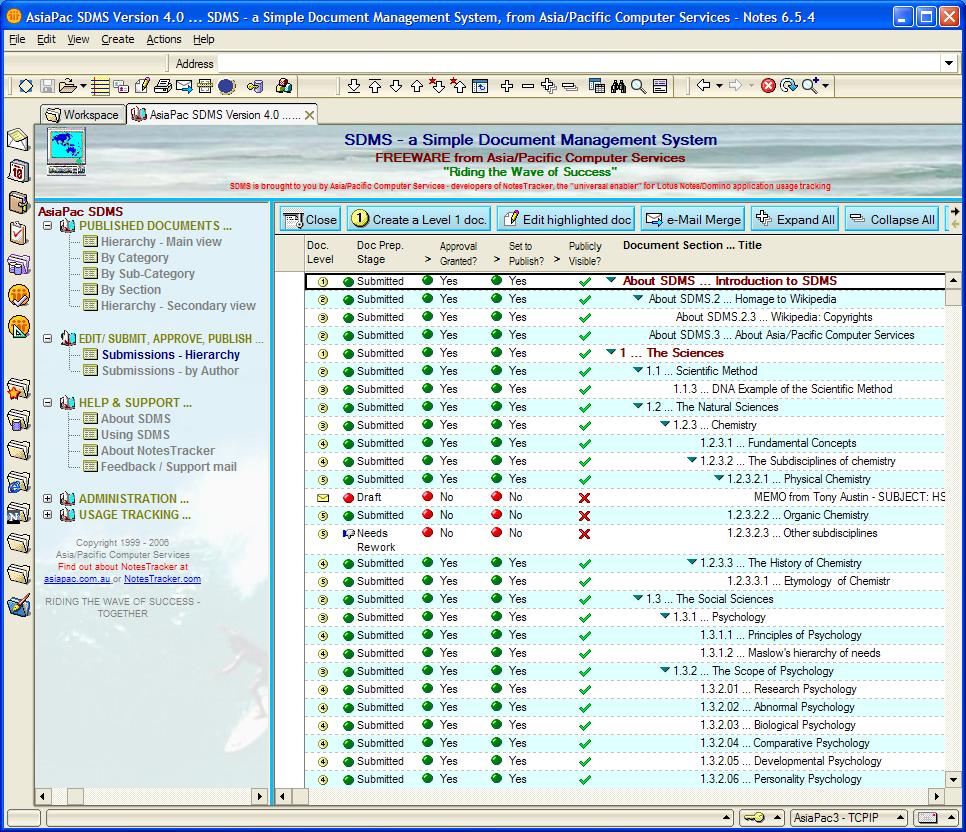 SDMS -- the Simple Document Management System -- now also has the same handy "mail merge" function, together with a major new "publishing life cycle" capability so that instead of just (as previously) being able to create/edit/submit documents, they must now be approved and finally be released for publishing.
According to the SDMS design philosophy, the publishing steps are designed to be simple to carry out.
Of course, as before SDMS has our powerful NotesTracker usage tracking capability built in.
Note: If you happened to download SDMS Version 4.0 yesterday, please be aware that there's already an updated version 4.01 available! It released this less than an hour ago this morning (07 November 2006, Melbourne time). An enhancement was made to the way that editing of the SDMS Database Profile Document is managed.
You'll find links to both the SDMS and the CAPTURE download pages on our web site's home page: that is, either asiapac.com.au or its mirror notestracker.com
Monday, November 06, 2006
SOA's Business Value (three articles)
Neil Ward-Dutton (Research Director at Macehiter Ward-Dutton) has penned three useful articles about Service Oriented Architecture:
- SOA’s Business Value (Part I of III) - Understanding the “S” and the “A” of SOA ...
In order to kick things off, I want to start from first principles. But I won’t bore you with talk of SOAP, WSDL, UDDI or any one of a hundred other acronyms. Instead I want to concentrate on a broader perspective of what the “S” and the “A” in SOA mean. In my mind, both “service” and “architecture” have meaning far beyond the context within which most discussion of SOA is taking place. ... SOA makes most sense as a way of thinking about IT which explicitly recognises that all IT organisations are service providers, with customers which have a variety of needs. And SOA should help IT organisations act in a systematic way which improves the overall quality of the service that they provide to those customers. - SOA’s Business Value (Part II of III) - SOA is about much more than integration using Web services technologies – it has the potential to enable IT and the business to start to talk and collaborate using a common language. In our research, we’ve found that there are four steps involved in getting to this common language: using SOA to increase software flexibility; increase software reuse; increase the comprehensibility of IT to the business; and lastly, increase the visibility of the value of IT.
- SOA's Business Value (Part III of III) - SOA, done right, can show the way for IT organisations to clearly demonstrate the value they provide to their "customers" - the businesses they work within.
STWebContact -- a nice alternative to Sametime Links
Andrei Kouvchinnikov -- a Lotus Sametime and Java enthusiast and now a Web buddy of mine, or "mate" as we prefer to say here Down Under -- a few days ago gave me the opportunity to test his new baby "Wimbo" or STWebContact to use its official product name. Andrei writes:
STWebContact is a web application for Sametime text messaging and presence awareness. It can be used from web browsers which support AJAX, such as Firefox, Internet Explorer, Opera.
STWebContact has functionality similar to Sametime Links (STLinks). In difference to STLinks, this web client does not require Java or additional ActiveX components installed on the user's computer.
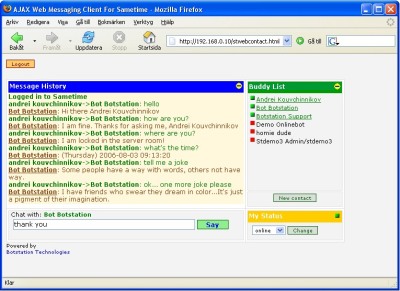
So if you've got Sametime installed and would like people to access its functions via the Web you owe it to yourself to consider STWebContact.
Subscribe to:
Posts (Atom)