Thursday, October 24, 2013

Trigger fingers kill people (guns don’t)

Of course, that’s just as absurd a statement as many others that are spouted out in the gun control debate.

Do guns become animate and start firing by themselves? Perhaps sensor-controlled ones would, but fortunately there aren’t many of those around, certainly not in movie theatres and schools, thank goodness. It’s what’s on the other end of the trigger finger that’s responsible, surely?

The above was prompted by reading Data suggest guns do in fact kill people in the online version of The Economist. This article concludes:

“It's really not terribly shocking that making it harder to get your hands on machines designed to kill people results in fewer people being killed. But we've worked very hard over the past few decades to convince ourselves otherwise.”

Go read the article and ponder the arguments for and against gun control.

Friday, October 11, 2013

A way to repair Windows Firewall, and Windows connectivity problems resuming from Sleep mode

During the last few days a Windows connectivity problem reared its ugly head. I used to get this from time to time with Windows 7, and now am suffering from it under Windows 8.

Every time that I resume from Sleep mode (which is several times per day) the wired Ethernet adapter would not reconnect and remained permanently offline in “Unidentified network” state, lasting for some minutes at least (I didn’t wait any longer, it should come online in 10 to 20 seconds at most).

While researching the above problem, thanks to trusty old Google search I stumbled  upon what seems to be a solution for a related painful problem that I described some months ago at Windows 8 will not save Network Discovery settings.

In summary, Windows Firewall went awry earlier this year, stopping LAN connections between this system and other Windows systems in my local area network. Since then, I’ve had to keep Windows Firewall turned off, and have experimented with several other firewalls which themselves caused a few problems: firstly being very intrusive (or “noisy”), plus making some other software quite difficult to keep running properly.

Consequently for the last few weeks I’ve been running without a software firewall and being alert for intrusions (as well as some benefit from the Cable modem’s built-in hardware firewall).

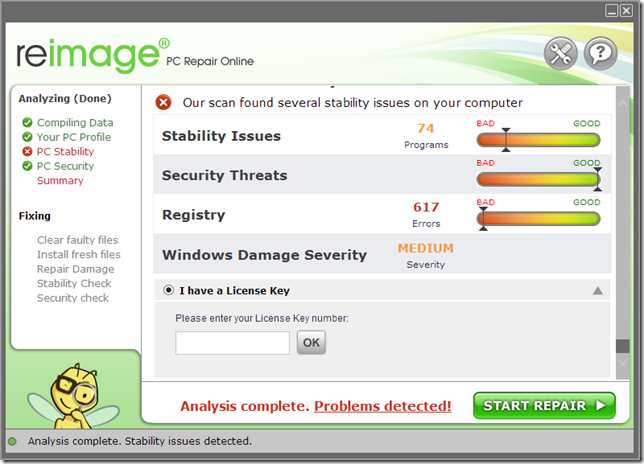
My discovery today -- while doing a Google search for Windows 8 repair “Windows Firewall” (this time with searchword “repair” that I hadn’t used on previous occasions) – was an interesting-looking repair tool called reimage that claims to give excellent results. I installed and ran it, and after a couple of minutes of scanning it presented the following results (the final part of the scan results only):
image

When I clicked on the “START REPAIR” button it opened a browser window inviting me to subscribe:

image

Being tight for funds at the moment (undergoing some treatment for melanoma, too many decades in the strong Australian sunshine I suppose), I declined payment.

So I went looking for a similar but hopefully FREE repair tool and luckily found one, which I used with good results and so would recommend to you. It’s available from Tweaking.com who describe themselves as “a group of tech heads with system performance on their brains.”

See the overview of their software and specifically (for this discussion) go to Repair Windows Firewall . . .
This will repair the Windows Firewall. The firewall is built into the system rather deep. And when the firewall becomes corrupt it can still block out side connections from coming in. Even when turned off. Also when corrupt you are unable to add any exceptions to the firewall.
Built into Windows “rather deep” is an understatement! As you will see from my earlier post the underpinnings of Windows Firewall are totally obscure. Microsoft themselves don’t provide any readily-accessible documentation for understanding how it’s all supposed to work, and how to systematically go about fixing things when it all goes wrong.

Anyway, even though it’s only described as being “for Windows XP, 2003, Vista, 2008 & 7” I installed and ran Repair Windows Firewall under windows 8. A little over a minute later I got the final screen:
image

But did it really fix my Network Discovery problem, could I browse other Windows systems on the LAN and could they browse this Windows 8 system?

Some quick testing proved that the answer was Yes, Yes, Yes.

Look again at the second-last last screenshot at Windows 8 will not save Network Discovery settings . . .

[image%255B60%255D.png]
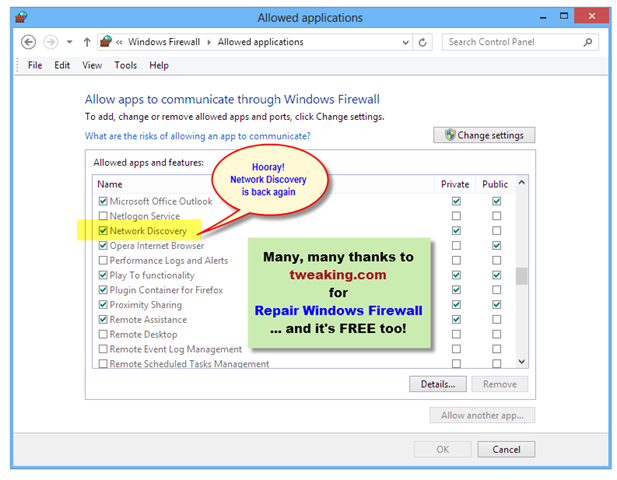
Thankfully now, after running Repair Windows Firewall, I see:
image

Many, many, many, many, many thanks to Tweaking.com for this Network Discovery firewall-related problem resolution, and I’ll certainly be trying out some of your other repair tools.

If you decide to try this Repair Windows Firewall tool, of course  it goes without saying (does it not) that you should take an appropriate backup first so that you can recover if Windows somehow gets messed up.

And life goes on for me . . . Now I only have to worry about the recent issue of Ethernet connectivity failure after resuming from Sleep mode.

Tuesday, September 03, 2013

Bitten again by faulty context menu items (shell extensions) in Windows

Every now and again, perhaps a few times per month, I need to carry out some sort of computer management such as device or disk management.

The way that I usually initiate the process is to right-click the Computer icon on the windows desktop and select the Manage option from the context menu:

image

Following this, the Computer Management window appears and I get on with my job:

image

However during the last month something changed, and late last week I discovered that no amount of clicking on the Manage context menu item would cause the Computer Management window to launch. While it’s easy enough  to use alternative ways of launching Device Management and Disk Management (or other such tasks), I was both puzzled and irritated that my favorite method had stopped working.

After a while it dawned on me that I had been in this quandary before, see my earlier post How to detect and disable faulty context menu items (shell extensions) in Windows 

I can happily report that by using the “binary search” technique explained in that post it  took me less than five minutes to determine that a newly-installed application called ExtremeCopy was the culprit:

image

As soon as I disabled the two shell extensions belonging to ExtremeCopy my problem went away. The developers of this copy utility at Easersoft need to review and correct their implementation of shell extensions (which I will point out to them).

The detection technique was very fast, the only delay was because it took a day or two for my previous experiences with all this it to bubble to the surface in my slow old brain!

Monday, June 17, 2013

NotesTracker Guide Version 5.3 has been added to Docstoc

NotesTracker is alive and well, and the guide for Version 5.3 Guide has been added to Docstoc.image

View or download the guide at
http://www.docstoc.com/docs/159510147/NotesTracker-Guide-Version-53

The guide introduces NotesTracker, explaining what it is and how it can be of value to your organization by enhancing your IBM Notes and Domino applications.

Following that is a section that shows how to configure and administer NotesTracker in each application, and finally a section for Notes developers explaining the steps used to add NotesTracker to the design of the applications.

Hyperlinks in the table of contents make it easy to jump to the various sections and subsections.

Legally, the bank owns a depositor’s funds–Super Scary!

What happened in Cyprus to bank depositors’ funds surely must have scared everyone a lot—except for the bankers themselves that is.

Those of us outside Cyprus would all have thought to ourselves “Thank goodness that can’t happen in my country” and gone on with our day-to-day existence.

But apparently that’s not the case already in some countries, and probably in more and more countries over time.

Read this scary article by Ellen Brown at the Web Of Debt website:
It Can Happen Here: The Confiscation Scheme Planned for US and UK Depositors

Apparently New Zealand plus probably other countries are planning something similar.

“Can the banks do that?” she asks (emphasis mine):

Although few depositors realize it, legally the bank owns the depositor’s funds as soon as they are put in the bank. Our money becomes the bank’s, and we become unsecured creditors holding IOUs or promises to pay. (See here and here.) But until now the bank has been obligated to pay the money back on demand in the form of cash. Under the FDIC-BOE plan, our IOUs will be converted into “bank equity.” The bank will get the money and we will get stock in the bank. With any luck we may be able to sell the stock to someone else, but when and at what price? Most people keep a deposit account so they can have ready cash to pay the bills.

. . . If our IOUs are converted to bank stock, they will no longer be subject to insurance protection but will be “at risk” and vulnerable to being wiped out, just as the Lehman Brothers shareholders were in 2008.

To become even more scared, you only have to read an earlier post of hers:
A Safe and a Shotgun or Publicly-owned Banks? The Battle of Cyprus

This has got me pondering how to make my funds safer. Stuffed under the mattress, or buried in a biscuit tin under the lemon tree in the back yard?

Sunday, June 16, 2013

NotesTracker Guide Version 5.3 has been added to Scribd

NotesTracker is alive and well, and the guide for Version 5.3 Guide has been added to Scribd.image

View or download the guide at
http://www.scribd.com/doc/148077501/NotesTracker-Version-5-3-Guide

The guide introduces NotesTracker, explaining what it is and how it can be of value to your organization by enhancing your IBM Notes and Domino applications.

Following that is a section that shows how to configure and administer NotesTracker in each application, and finally a section for Notes developers explaining the steps used to add NotesTracker to the design of the applications.

Hyperlinks in the table of contents make it easy to jump to the various sections and subsections.

Thursday, June 13, 2013

Some free widgets for your website

I just stumbled upon a range of free widgets that should add value to your web sites, blogs and other online publications.

Because of the nature of the website (oilprice.com) the widgets are all related to energy, precious metals, and related financial matters.

You’ll find them here:
Energy Widgets | Metal Widgets | Financial Widgets | News Widgets | Clocks Widgets

Here are a few of them in action…


Sunday, June 09, 2013

Do dogs show empathy? It could well be so.

Just back from checking that our pooch was comfortable on a clear. cool early Winter’s night here Down Under in Melbourne. He was okay, and seemed to appreciate the visit!

Back inside, I went to ABC Australia’s Catalyst science show’s website to catch up on their latest episode. You may recall that back in April I pointed out a story about dogs cute appearance probably being due to their facial musculature (see Cute Canines, Eyes That Engage You and watch the video).

Well, in this week’s new episode there’s another intriguing story, this one about dog empathy which the story describes as:

“. . . the naturally occurring subjective experience of similarity between the feelings expressed by self and others without losing sight of whose feelings belong to who. Translated, what that means is to have true empathy, you have to not only feel someone's pain, you have to know that the emotion belongs to them and not to yourself.”

Watch the video. What do you think?

I’m somewhat convinced. I do know that if I’m playing with my dog (and others before him), I only have to howl or yelp in a certain way – making the sort of sound you hear if you accidentally tread on the dog, or if the dog gets bitten in a dogfight – then consistently the dog will immediately stop whatever he’s doing and cuddle up close to to me as if to offer sympathy.

You only have to do a simple search or two and you’ll find much other material about the unique dog-human relationship.

Saturday, June 08, 2013

Fascinating Facts about Flu - What Flu is and isn’t

As southern winter sets in here Down Under, I’m aware that for the previous two years I suffered a number of quite nasty attacks of what I called “the Flu” – But was it really influenza, or something else, and will I succumb again this year despite again getting jabbed with Flu vaccine?

Just-published this first week of June 2013 is a “Facts about Flu” series of articles in The Conversation that sheds light on this topic. There are insights and clarifications, as well as lots of shadowy and dark areas where our knowledge remains deficient.

This excellent series is as follows:

Part one: Of influenza, flu, potions and key opinion leaders

Part two: Influenza vaccine for 2013: who, what, why and when?

Part three: H1N1, H5N1, H7N9? What on earth does it all mean

Part four: The Tamiflu saga shows why all research data should be public

Part five: CSL’s flu vaccine leaves a hole in Australia’s pandemic plan

Part six: Should flu shots be mandatory for health-care workers?

Part seven: The Holy Grail of influenza research: a universal flu vaccine

Part eight: Is it really the flu? The other viruses making you ill in winter

Part nine: The heart of the matter: how effective is the flu jab really?

Monday, June 03, 2013

Enjoy excellent online jigsaw puzzles at Jigsaw Explorer

I just came across a site with outstanding interactive jigsaw puzzles, go to Jigsaw Explorer if such puzzles turn you on.

For example, this tower at Beget, Spain (with the option selected to remind you what the “box top” is for the puzzle):

image

Actually, rather than jigsaws my definite preference is for word puzzles, not only as a consumer but and in the past I’ve created some crosswords that were based around various themes in information technology.

Unfortunately they’re now offline after a redesign of the site where I created them, and the site owner isn’t interested in bringing them back to life.

I really should create some more of these interactive crosswords, this time on my own site so that nobody can take them offline. I used the highly recommended Crossword Forge to build them:

Crosswords take a long time to compile, especially when the choice of words is confined to a theme rather than the general language. Software like Crossword Forge significantly eases the burden.